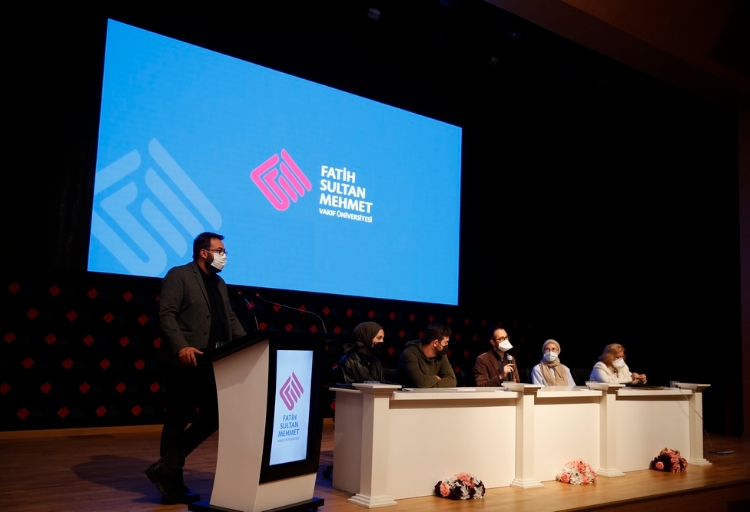
With the theme of "Clean Environment for a Healthy World", Faculty of Architecture and Design organized a Healthy Architecture Symposium special for the World Architects Day celebrated on October 4 this year.
Professor of Architecture, Dr. At the symposium held in the Haliç Campus conference hall, moderated by Hakkı Can Özkan, the role of architects in the formation of healthy cities, the accessibility of different age groups to the spaces of the city, expectations from the public space after the epidemic and the epidemic process from the eyes of architecture students were discussed.
Head of Architecture Department Prof. Dr. Ayfer Aytuğ discussed the relationship between healthy cities and architecture, healthy city studies of international organizations and the situation in our country.
Stating that healthy cities, defined as places that prioritize people and the planet, are inclusive, anti-discrimination, trust, flexibility, ethics and values oriented, giving priority to human and social capital investment. Prof. Dr. Aytuğ said:
“Having the health and well-being of both people and the planet at the center of all internal and external policies of the city ensures a strengthened and coherent city health policy. A healthy city creates an accessible social, physical and cultural environment that facilitates understanding of health and well-being. It integrates equity and sustainability in health into urban development and planning. Enhanced inclusion is essential in the use and management of common areas.”
Improvement is possible with good design and planning
Stating that the natural built environment, local economy, society and lifestyle are important determinants in healthy urban planning, Aytuğ said, "In this way, bad health caused by the risks attributed to urban planning, including air pollution, road injuries, unemployment and poor housing, can be prevented with good design and good planning. Health care costs decrease over time. Good design also creates financial, social and environmental value. A well-designed healthy development will also add economic value by increasing sales and rentals of residential units, bringing higher return on investment.” he said.
Stating that existing urban conditions and single-centered decisions bring along problems, Aytuğ underlined that urban designers, landscapers, architects, zoning boards and municipal councils should act together on planning and urban design strategies.
“Cities should be accessible to all”
Deputy Head of Architecture Department Dr. Instructor Member Burcu Balaban Ökten evaluated the accessibility of urban spaces through the increasing needs of children, adults, disabled individuals and especially the elderly to use public spaces during the epidemic period.
Pointing out that it is important for the mental and physical health of elderly people, whose connections with the street were minimized at the beginning of the epidemic period, to participate in life without being isolated, Ökten said: Loneliness has grown. It has become important to arrange the houses according to them, to receive social support, to have parks and places to walk. In the design of residences and public spaces, it is necessary to understand the needs of elderly people correctly and to make physical designs that enable them to move more easily. It is essential to design places where they can sit in elevators, ramps, parks and gardens, and areas for physical activities.” used the phrases.
Noting that it is important for disabled individuals to participate in the city on their own, Ökten said, “Architects should enable disabled individuals to act on their own. Cities must be accessible to all. We have seen how important public spaces and green spaces are, especially during the epidemic. We must be based on universal and inclusive design.” said.
“User preferences have changed”
Mesut Dural, a research assistant at the Department of Architecture, talked about the priorities of perceiving the environment during the epidemic. Stating that the expectations of individuals from the architectural space have changed with the epidemic, Dural said, “Our perception priorities have changed in the epidemic. We started to prefer open or semi-open spaces, we wanted indoor areas to be ventilated, we paid attention to social distance, we avoided contact. The expectation of gardens, terraces and balconies has increased. The epidemic showed us how important open and semi-open spaces are in architecture. These changes in user preferences will also guide future designs.” made its assessment.
Architecture students online collaboration
Esma Nur Kamar and Buğra Arslan, third year students of the Department of Architecture, also talked about the activities they did as a team in order to maintain active studentship during the time they were away from face-to-face education due to Covid-19. Stating that they spent every day of the week to the fullest with the workshops, seminars, researches, trips and social responsibility projects they started online as the Architecture Club, the students experienced the beauty of being together even though they were apart from the campuses.
Stating that they established a system where different classes follow each other, Buğra Arslan said, “We have created a system where sophomores will support first graders and first graders will support preparatory students. We were divided into different units. As a social responsibility unit, we sewed pencil boxes for a school in Bitlis. Our social media unit has prepared content to keep our accounts active. We started our Architecture Dictionary project. Our travel team shared their own travel videos. The epidemic process has been a period in which we have had different experiences, our enthusiasm for obtaining information, our love for the profession and our determination have increased. Even though we couldn't see each other face to face, we did things that we really enjoyed.” he said.
Stating that they managed to turn the epidemic process into an advantage for themselves, Esra Nur Kamar said, “A system was formed in which we filled every day of the week with activity. Architecture is an intense discipline, it would be very difficult to dedicate an activity to each day without online activities. Online platforms, where everyone creates their own space, helped increase the number of participants and efficiency.” said.